For EDCI 336, my technology and education course, I learned how to make a podcast. Myself and another of my classmates reviewed a video of a circus-arts performance.
This was the video we reviewed. Check it out!
And here's my review.
December 8, 2010

November 17, 2010
Just try harder
From high school, I distinctly remember making the statemen "I don't have to try very hard because I'm pretty good at math." I said it with confidence and with certainty; I did well on math tests without studying, I must be good at math.
As I progressed in my post secondary degree, I started to realize that I actually had to try, not just in math, but in all my subjects. I started to make statements like "I studied every day for the entire term, of course I did well in advanced organic chemistry."
I remember being frustrated by a friend who continually told me that I didn't have to worry about tests, assignments and the like because I was smart and always did well. She brushed it off as being beside the point whenever I pointed out that I spent hours in profs offices, that I studied regularly, and that I had done every single not-for-marks assignment. She was never willing to recognize how much effort I put into my courses. She continued to believe that I was simply "smart."
I've been learning about students' belief systems regarding intelligence and how those beliefs affect their academic performance. It's astounding. From what I've read, there are two general beliefs held: the belief that intelligence is an inherent, fixed quality and the belief that intelligence is a fluid quality that can be improved by applying oneself. The fascinating thing is how these beliefs affect student outcomes:
|
| Intelligence is fixed | Intelligence is malleable |
| Students’ goal | To look smart, even if they learn less | To learn, even if they make mistakes |
| What does failure mean? | Failure means low intelligence | Failure means low effort, poor strategy |
| What does effort mean? | Effort means low intelligence | Effort activates and uses intelligence |
| Strategy after difficulty | Less effort | More effort |
| Self-defeating defensiveness | High | Low |
| Performance after difficulty | Impaired | Equal or improved |
If students believe that effort is a way to be intelligent, they tend to persist in both enjoyment of subjects and are better able to sustain effort in a difficult problem. If students believe that you’re born with a certain amount of intelligence, every failure (or perceived failure) strikes at the heart of something valued-their intelligence.
Can we change these beliefs? And if so, how?
November 3, 2010
Set the hook
In many of my classes and amongst my colleagues there exists this idea that students need to be motivated in order to learn.
I wholeheartedly agree.
There is also an idea that in order for students to want to learn there should be a "hook," an idea to reel them in and make them interested enough in the subject to want to continue learning.
Once again, I think this makes sense.
In science we have thousands of "teachable moments" when we can do fascinating demonstrations, or discuss the science of the last CSI episode. Chemistry in particular is full of bangs and changing colours.
Students get dismayed that there is so much to learn that is not the bangs, colour changes, or "fun stuff." Most science is fascinating, intriguing, active, and leads to fascinating results. But it is not instantaneous and it does demand a certain level of automaticity within specific, relatively boring skill sets. Knowing how to do molar calculations is neither exciting nor motivating, but it is necessary for true scientific literacy in chemistry.
So how do we bridge the gap? How do we engage in those "teachable moments" while still providing adequate practice that will make our students competent practitioners?
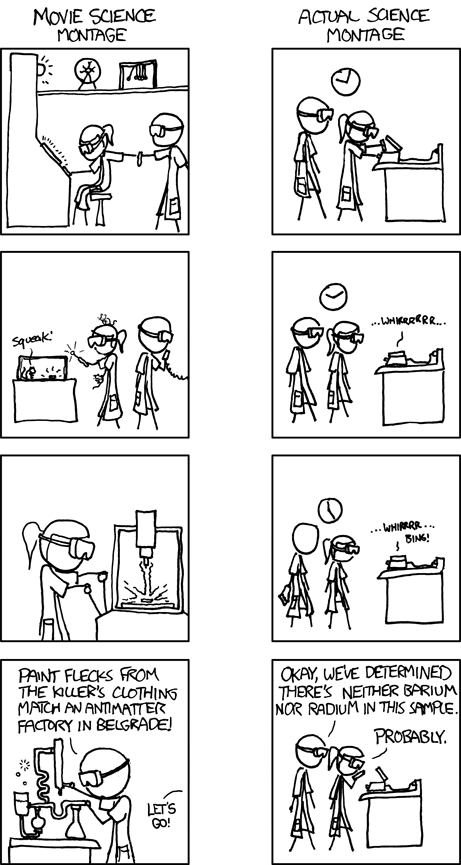
I wholeheartedly agree.
There is also an idea that in order for students to want to learn there should be a "hook," an idea to reel them in and make them interested enough in the subject to want to continue learning.
Once again, I think this makes sense.
In science we have thousands of "teachable moments" when we can do fascinating demonstrations, or discuss the science of the last CSI episode. Chemistry in particular is full of bangs and changing colours.
Students get dismayed that there is so much to learn that is not the bangs, colour changes, or "fun stuff." Most science is fascinating, intriguing, active, and leads to fascinating results. But it is not instantaneous and it does demand a certain level of automaticity within specific, relatively boring skill sets. Knowing how to do molar calculations is neither exciting nor motivating, but it is necessary for true scientific literacy in chemistry.
So how do we bridge the gap? How do we engage in those "teachable moments" while still providing adequate practice that will make our students competent practitioners?
October 27, 2010
A fabulous math rant!
This is a wonderful rant about the true nature of mathematics. Rather than listening to me, check it out.
October 1, 2010
The mathematics of surfing
I doubt many people think of mathematics when they think of surfing. But to me, surfing really speaks of the beauty of math. Regular waves. Periods. Angles between board, rider and wave. Even the shape of the underside of the board, a regular parabola, affects how you ride. It's all completely descriptive of mathematics.

 I edited this image in Piknic. I changed the contrast and sharpness, the temperature, added text and cropped the image.
 This photo I edited in Sumopaint. I added text, layer effects, and changed the contrast. This editor was much less intuitive for me. However, I think this would be a useful tool if I was using a photograph as an image, rather than as a photograph. Being able to insert shapes might help illustrate the geometric nature of the world.
If more students were exposed to those ideas while learning about sinusoidal wave graphs, would they be more engaged in the lesson?
For me, the experience I have while solving a mathematical problem is similar to that which I get while struggling to catch a wave. There's anticipation, panic, frustration and triumph when I finally get it. It's not easy, nor is it completely intuitive for me, but it is exiting, fascinating and keeps me coming back for more.
Here's a photo that I took after a beautiful morning surf in Tofino this past July.

 I edited this image in Piknic. I changed the contrast and sharpness, the temperature, added text and cropped the image.
I found this tool very intuitive and easy to use. I felt that this photo editor would allow me to do all that I would ever want to do with my photos in terms of editing.
 This photo I edited in Sumopaint. I added text, layer effects, and changed the contrast. This editor was much less intuitive for me. However, I think this would be a useful tool if I was using a photograph as an image, rather than as a photograph. Being able to insert shapes might help illustrate the geometric nature of the world.
September 23, 2010
The math literacy problem
I've been talking to a number of my classmates for the last couple weeks and a theme is emerging for me. The majority of people do not consider themselves "math people." What I've started to wonder is why.
From the get-go, I was a math person. Math makes sense to me. Its patterns and rules, its hidden intricacies, and its ability to describe the incredibly complicated process of, say, falling. But it seems that insight is not universal. Or is it?
Is it that people don't understand "math" or that they got stuck somewhere along the way and never felt success again? Is it so unusual to understand patterns? Or to follow that if I have pies each cut into 6 and I have 5 slices that I have somewhat less than one pie? Is it a challenge to see that when an object is thrown up into the air, its distance above the ground is predictable via an equation? Are those ideas the hard part, or is it that people got stuck somewhere and never moved on?
It's culturally acceptable to be bad at math. Why? Why is it okay to be illiterate in math, but not okay to be illiterate in reading?
I'm not suggesting that math makes sense to everyone. You actually don't have a math brain? Fine. But before you decide that, are you sure that it's not that somewhere along the way you stumbled over an idea?
My greatest challenge as a math teacher, I predict, will be finding those stumbles and getting students past them while moving through the curriculum. If I can do that for even half my students, will the generation coming through be less inclined to say "I'm not a math person"?
Math problems are a puzzle. There's a beginning and an end, but how you get between those two points is entirely up to you. You know if you solved the puzzle if you got the right answer. There's a great deal of satisfaction in solving the puzzle.
For explanations of math at any level
http://www.math.com/
To learn more about Mathletics, the online program engaging students in fun and challenging math learning
http://www.mathletics.ca/
For super fun, content specific math games (seriously addictive)
http://www.mathplayground.com/
From the get-go, I was a math person. Math makes sense to me. Its patterns and rules, its hidden intricacies, and its ability to describe the incredibly complicated process of, say, falling. But it seems that insight is not universal. Or is it?
Is it that people don't understand "math" or that they got stuck somewhere along the way and never felt success again? Is it so unusual to understand patterns? Or to follow that if I have pies each cut into 6 and I have 5 slices that I have somewhat less than one pie? Is it a challenge to see that when an object is thrown up into the air, its distance above the ground is predictable via an equation? Are those ideas the hard part, or is it that people got stuck somewhere and never moved on?
It's culturally acceptable to be bad at math. Why? Why is it okay to be illiterate in math, but not okay to be illiterate in reading?
I'm not suggesting that math makes sense to everyone. You actually don't have a math brain? Fine. But before you decide that, are you sure that it's not that somewhere along the way you stumbled over an idea?
My greatest challenge as a math teacher, I predict, will be finding those stumbles and getting students past them while moving through the curriculum. If I can do that for even half my students, will the generation coming through be less inclined to say "I'm not a math person"?
Math problems are a puzzle. There's a beginning and an end, but how you get between those two points is entirely up to you. You know if you solved the puzzle if you got the right answer. There's a great deal of satisfaction in solving the puzzle.
For explanations of math at any level
http://www.math.com/
To learn more about Mathletics, the online program engaging students in fun and challenging math learning
http://www.mathletics.ca/
For super fun, content specific math games (seriously addictive)
http://www.mathplayground.com/
September 22, 2010
Reconciling
So far, the whole experience of becoming a teacher is foreign to me. That's not true. I've been a teacher in many different capacities for years. But this format of school is not what I've experienced before. I hope to reconcile my training as a student and my training as a teacher to a more complete understanding of education.
Subscribe to:
Comments (Atom)