I wholeheartedly agree.
There is also an idea that in order for students to want to learn there should be a "hook," an idea to reel them in and make them interested enough in the subject to want to continue learning.
Once again, I think this makes sense.
In science we have thousands of "teachable moments" when we can do fascinating demonstrations, or discuss the science of the last CSI episode. Chemistry in particular is full of bangs and changing colours.
Students get dismayed that there is so much to learn that is not the bangs, colour changes, or "fun stuff." Most science is fascinating, intriguing, active, and leads to fascinating results. But it is not instantaneous and it does demand a certain level of automaticity within specific, relatively boring skill sets. Knowing how to do molar calculations is neither exciting nor motivating, but it is necessary for true scientific literacy in chemistry.
So how do we bridge the gap? How do we engage in those "teachable moments" while still providing adequate practice that will make our students competent practitioners?
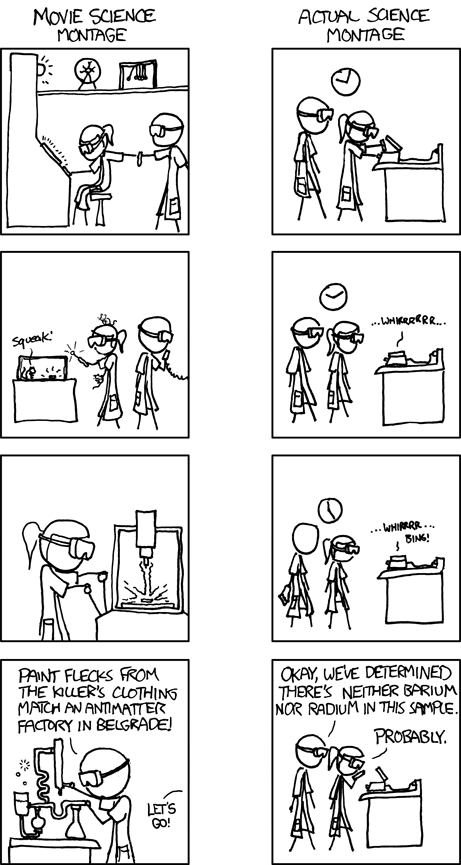

Oh man that cartoon is so true.
ReplyDeleteGood question - one that I think we will each have to do some experimenting with our students to be able to answer.
There is a huge spectrum of theories, ideas and experiences that defines what motivates people.Here is another interesting post about this subject
ReplyDeletehttp://mot-to-work.blogspot.com/